
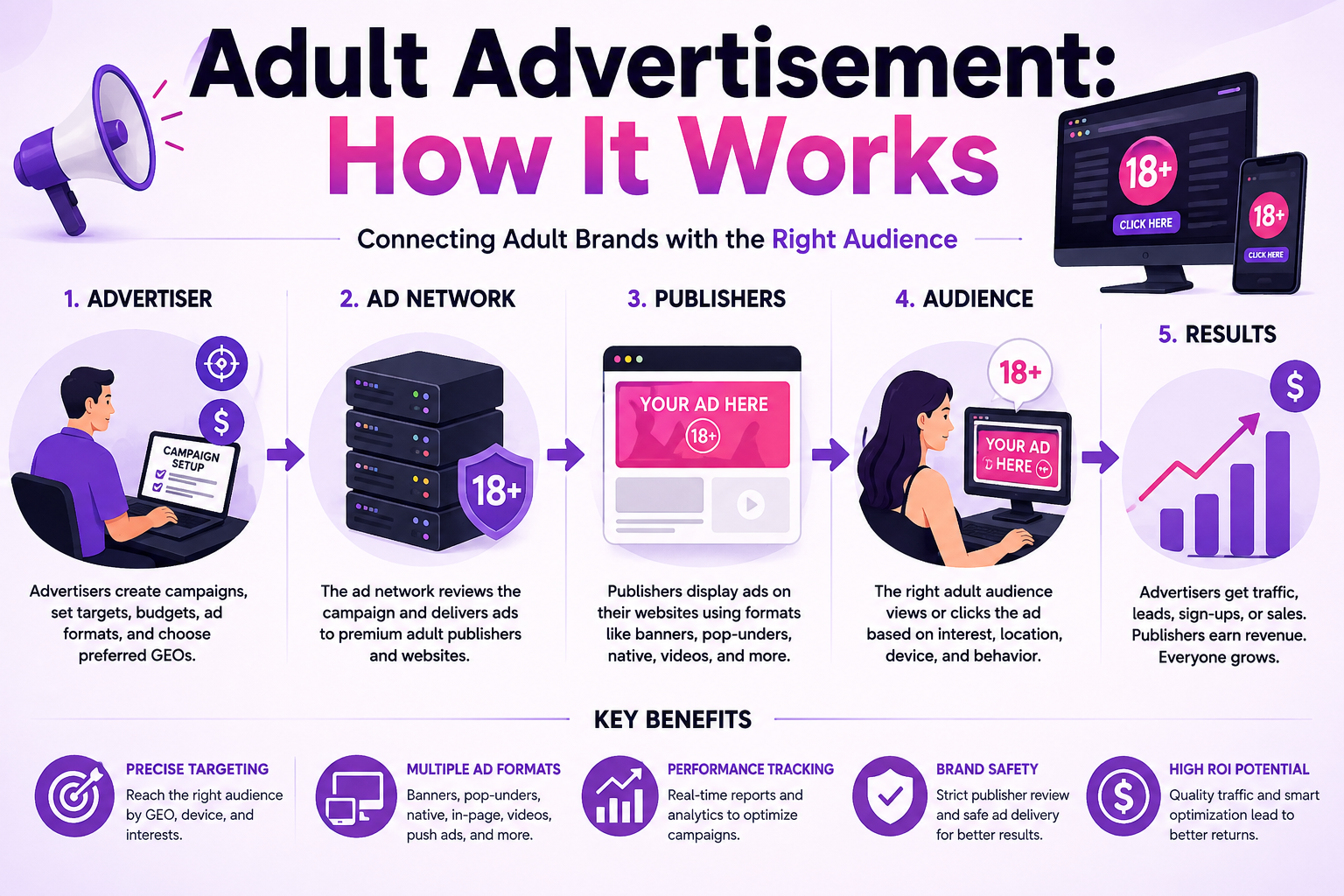
Adult Advertisement: How It Works
Adult advertisement is a specialized form of digital marketing that promotes products, services, websites, and brands to adult audiences. Because mainstream advertising platforms often apply strict restrictions to adult-oriented campaigns, advertisers and publishers frequently use specialized advertising networks and direct partnerships.
Understanding how adult advertisement works is important for advertisers, publishers, website owners, and marketers. A successful campaign requires more than simply placing an advertisement on a website. Factors such as traffic quality, audience location, device type, ad format, pricing model, landing-page performance, and compliance can significantly affect results.
This guide explains the fundamentals of adult advertisement, the most common advertising formats, pricing models, targeting options, optimization methods, and important considerations for running campaigns effectively.
What Is Adult Advertisement?
Adult advertisement refers to digital advertising designed for products, services, platforms, or websites intended for adults. These advertisements may appear on specialized websites, content platforms, entertainment sites, dating services, affiliate websites, and other environments where adult audiences are permitted.
The objective can vary depending on the advertiser. Some campaigns focus on generating website visits, while others aim to increase registrations, subscriptions, sales, app installations, or brand awareness.
Unlike general digital advertising, adult advertisement operates within a more restricted advertising environment. Advertisers must consider the policies of advertising networks, publishers, payment providers, hosting companies, and applicable laws.
How Adult Advertising Differs From Mainstream Advertising
The biggest difference is the availability of advertising inventory. Many mainstream platforms restrict or prohibit adult-oriented advertising, which means advertisers often rely on specialized networks and publishers.
Other differences include:
- More specialized audiences
- Greater importance of traffic source
- Different advertising formats
- Strong geographic targeting
- Specialized conversion tracking
- Different compliance requirements
- Greater reliance on direct publisher relationships
For this reason, choosing the right advertising network and publisher can have a major effect on campaign performance.
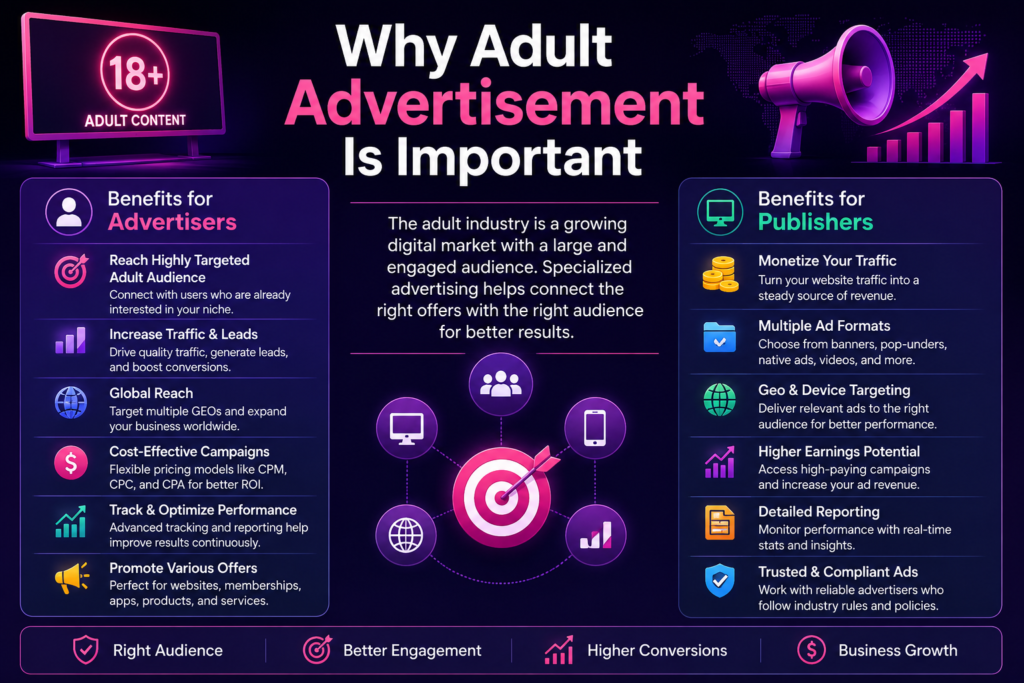
Why Adult Advertisement Is Important
The adult digital market has a large online audience, creating demand for advertising solutions that connect relevant advertisers with appropriate publishers.
A specialized advertising campaign can help businesses reach an audience that may already have an interest in the advertised category. Instead of distributing advertisements broadly, advertisers can select traffic according to geographic location, device, website category, and other available targeting parameters.
Benefits for Advertisers
Advertisers can use adult advertising to:
- Increase targeted website traffic.
- Promote new websites or platforms.
- Generate registrations and leads.
- Promote subscription-based services.
- Increase brand visibility.
- Test different geographic markets.
- Reach desktop and mobile audiences.
- Measure campaign performance through tracking.
The effectiveness of a campaign depends heavily on traffic quality and the relationship between the advertisement and the audience.
Benefits for Publishers
Website publishers can monetize their available advertising space by working with suitable advertising networks or advertisers.
Common publisher benefits include:
- Additional revenue
- Multiple advertising formats
- Geographic targeting
- Campaign management tools
- Performance reporting
- Flexible inventory options
Publishers should carefully evaluate advertisements before accepting them to maintain website quality and comply with applicable regulations.
Common Adult Advertisement Formats
Different advertising formats serve different objectives. The best format depends on the website, audience, campaign goal, and available inventory.
| Ad Format | Typical Use | Main Advantage |
| Banner Ads | Brand and website promotion | High visibility |
| Video Ads | Engagement and awareness | Strong visual impact |
| Native Ads | Content-based promotion | Natural placement |
| Pop-Under Ads | Traffic generation | Additional reach |
| Push Ads | Direct user engagement | Strong visibility |
| In-Page Ads | Mobile traffic | Flexible placement |
| Interstitial Ads | Full-screen promotion | High exposure |
| Direct Links | Traffic and affiliate campaigns | Simple implementation |
Banner Advertising
Banner advertisements are among the most recognizable digital advertising formats. They can be placed in different areas of a website, including headers, sidebars, content sections, and footers.
Banner performance depends on factors such as:
- Creative quality
- Banner size
- Website placement
- Audience relevance
- Geographic location
- Frequency
- Landing-page quality
A well-designed banner should communicate its main message quickly without overcrowding the visual space.
Video Advertising
Video advertising uses short video creatives to communicate information or promote a service.
Video can be effective when the advertiser needs more space to explain a product, service, or offer. However, file size, loading speed, sound settings, and mobile compatibility should be considered carefully.
Native Advertising
Native advertisements are designed to fit naturally into the surrounding website content. They can appear as recommended content, sponsored listings, or other content-based placements.
The objective is to provide an advertising experience that matches the format of the publisher’s website while clearly identifying sponsored material where required.
Pop-Under Advertising
A pop-under advertisement opens a promotional page or window behind the user’s current browsing window. It can generate substantial traffic when used on websites with large audiences.
However, frequency management is important. Excessive advertising can negatively affect user experience and may reduce the long-term value of a publisher’s traffic.
Understanding Adult Advertisement Pricing
Advertising networks commonly use several pricing models. Understanding these models helps advertisers compare campaigns and estimate costs.
CPM
CPM means Cost Per Mille, or cost per 1,000 impressions.
For example, if a campaign has a CPM of $2, the advertiser pays approximately $2 for every 1,000 ad impressions.
The basic formula is:
Advertising Cost = Impressions ÷ 1,000 × CPM
CPM is particularly useful for campaigns focused on exposure and traffic volume.
CPC
CPC means Cost Per Click. Under this model, the advertiser pays when a user clicks the advertisement.
CPC can be useful when the primary goal is generating website visits rather than simply displaying advertisements.
CPA
CPA means Cost Per Action. The advertiser pays when a defined action occurs, such as a registration, purchase, or subscription.
CPA campaigns can reduce some advertising risks for advertisers because payment is connected to a measurable result.
Revenue Share
In a revenue-share model, the publisher or advertising partner receives a percentage of revenue generated from referred users or customers.
This model is common in performance-based marketing and affiliate partnerships.
Geographic Targeting
Geographic targeting is one of the most important elements of digital advertising.
Advertisers can often select specific countries or regions depending on the inventory available from an advertising network.
For example, a campaign may focus on:
- United States
- United Kingdom
- Germany
- Canada
- Australia
- European markets
- Global traffic
Different countries can produce significantly different CPMs, conversion rates, and traffic volumes. Therefore, advertisers should evaluate each GEO independently rather than assuming that all traffic performs equally.
Why GEO Matters
A campaign receiving large amounts of traffic does not necessarily produce strong results. The value of an impression depends on the audience and the advertiser’s objectives.
For this reason, campaign reports should be reviewed by GEO to identify:
- High-converting countries
- Expensive traffic sources
- Low-performing locations
- Strong CPM opportunities
- Areas requiring optimization
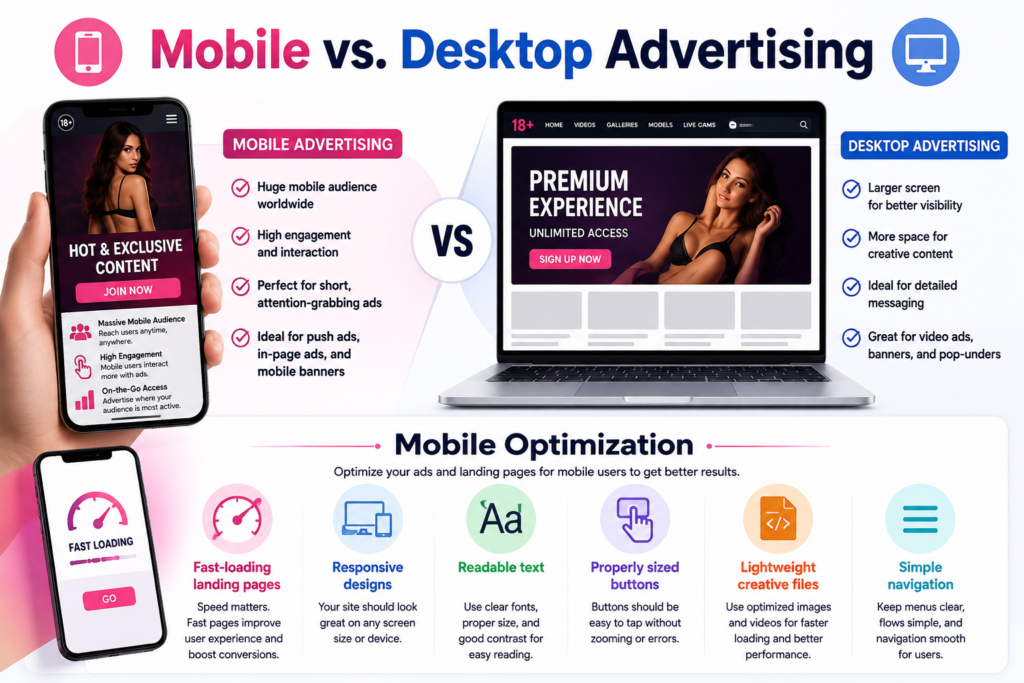
Mobile vs. Desktop Advertising
Mobile and desktop users can behave differently, so advertisers should consider device targeting when available.
Mobile advertising benefits from the large amount of time users spend browsing on smartphones. However, advertisements must be designed for smaller screens.
Desktop advertising provides more screen space and can be suitable for larger banners, video formats, and detailed landing pages.
Mobile Optimization
For mobile campaigns, advertisers should focus on:
- Fast-loading landing pages
- Responsive designs
- Readable text
- Properly sized buttons
- Lightweight creative files
- Simple navigation
A campaign can have strong traffic but poor conversion performance if the landing page is difficult to use on mobile devices.
How to Choose an Adult Advertising Network
Selecting an appropriate advertising network is an important decision for any campaign.
Traffic Quality
Traffic volume alone is not enough. Advertisers should examine whether traffic is genuine, relevant, and suitable for their campaign objectives.
Important metrics can include:
- Impressions
- Clicks
- Click-through rate
- Conversion rate
- Bounce rate
- Geographic distribution
- Device distribution
Available Ad Formats
Different campaigns require different formats. Before starting, check whether the network offers the advertising format needed for the campaign.
A network may specialize in banners, video, native advertising, pop-under traffic, push advertising, or several formats.
Targeting Options
Useful targeting options may include:
- Country
- Region
- Device
- Operating system
- Browser
- Traffic source
- Website category
- Frequency
- Time of day
The more relevant the targeting options, the easier it can be to test different audience segments.
Reporting and Analytics
Reliable reporting allows advertisers to understand where their money is being spent.
A useful dashboard should provide information about impressions, clicks, costs, traffic sources, and other available campaign metrics.
How to Improve Adult Advertisement Performance
Campaign optimization should be based on measurable results rather than assumptions.
Test Multiple Creatives
Using several advertisements allows advertisers to determine which creative produces stronger engagement.
Test variables such as:
- Headlines
- Images
- Calls to action
- Layout
- Banner sizes
- Video versions
- Landing pages
Do not change every variable at once if the goal is to identify the reason for performance differences.
Optimize Landing Pages
The advertisement is only the first part of the customer journey. After clicking, users arrive on a landing page.
A strong landing page should:
- Load quickly
- Match the advertisement
- Clearly explain the offer
- Work properly on mobile devices
- Provide straightforward navigation
- Use a clear call to action
A mismatch between an advertisement and landing page can reduce conversions.
Monitor Frequency
Showing the same advertisement too frequently can cause advertising fatigue. Users may stop noticing the creative after repeated exposure.
Frequency controls can help advertisers manage how often an individual user sees the same campaign when the network supports this feature.
Analyze Performance Regularly
Campaign optimization should be continuous.
Review performance according to:
- GEO
- Device
- Ad format
- Creative
- Publisher
- Traffic source
- Time period
If one segment consistently produces better results, the advertiser can consider allocating more budget toward that segment.
Compliance and Responsible Advertising
Compliance is an essential part of adult advertisement.
Advertisers and publishers should ensure that their campaigns comply with applicable laws and the policies of advertising networks and publishers.
Age Restrictions
Adult-oriented advertising should be presented only to appropriate adult audiences where required. Advertisers should understand the age-related requirements applicable to their market.
Advertising Policies
Every advertising network can have its own rules regarding acceptable advertisements, landing pages, creative content, claims, and targeting.
Before launching a campaign, advertisers should review the network’s current advertising policies.
Privacy and Data Protection
Advertisers using tracking technologies should understand applicable privacy and data protection requirements. Depending on the audience and jurisdiction, requirements may apply to cookies, analytics, consent mechanisms, and personal data processing.
Clear privacy practices can also improve user trust.
Measuring Campaign Success
Different advertisers define success differently. A campaign focused on awareness may prioritize impressions, while a performance campaign may focus on conversions.
Useful metrics include:
| Metric | What It Measures |
| Impressions | Number of advertisement views |
| Clicks | Number of user clicks |
| CTR | Percentage of impressions producing clicks |
| CPM | Cost per 1,000 impressions |
| CPC | Average cost per click |
| Conversions | Completed target actions |
| Conversion Rate | Percentage of visitors completing an action |
| ROI | Financial return compared with advertising cost |
Understanding CTR
CTR, or click-through rate, measures how often users click an advertisement after seeing it.
The formula is:
CTR = Clicks ÷ Impressions × 100
For example, if an advertisement receives 10,000 impressions and 100 clicks, the CTR is 1%.
CTR is useful, but it should not be evaluated alone. A campaign can have a high CTR and still produce poor results if the landing page does not convert visitors.
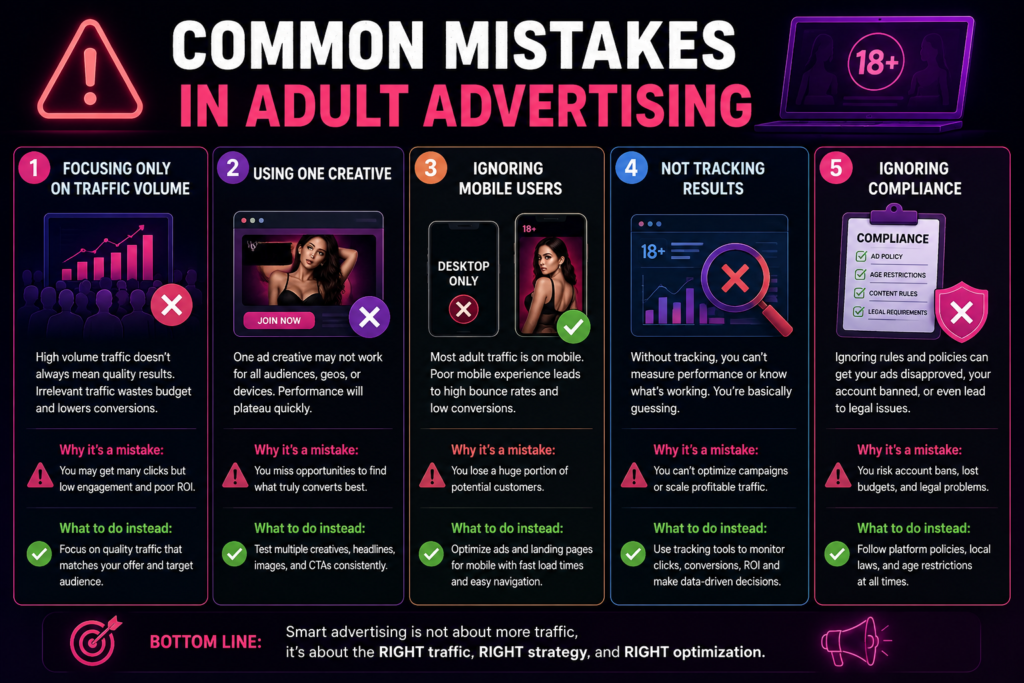
Common Mistakes in Adult Advertising
Several mistakes can reduce campaign performance.
Focusing Only on Traffic Volume
Large amounts of traffic do not automatically mean good performance. Quality and relevance are more important than raw volume.
Using One Creative
A single advertisement may not work equally well for every audience. Testing multiple creatives provides more information.
Ignoring Mobile Users
A large portion of digital traffic comes from mobile devices. Poor mobile experiences can reduce engagement and conversions.
Not Tracking Results
Without analytics, advertisers cannot accurately determine which campaigns, GEOs, or publishers are delivering value.
Ignoring Compliance
Advertising rules can vary by network and location. Failing to review applicable policies can result in campaign rejection or other problems.
Future of Adult Advertisement
Digital advertising continues to evolve as publishers, advertisers, and users adopt new technologies.
Several developments are likely to remain important:
- Better audience segmentation
- More advanced analytics
- Mobile-first advertising
- Video advertising
- Contextual targeting
- Automated campaign optimization
- Improved fraud detection
- More detailed performance reporting
Advertisers that focus on relevant audiences, strong creative materials, transparent measurement, and responsible practices are better positioned to adapt to these changes.
Frequently Asked Questions
What is adult advertisement?
Adult advertisement is digital advertising designed to promote products, services, websites, or platforms intended for adult audiences through suitable advertising channels.
What is CPM in adult advertising?
CPM means Cost Per Mille and represents the price paid for 1,000 advertising impressions.
Which adult advertising format is best?
There is no single best format. Banner, video, native, pop-under, push, and other formats can perform differently depending on the audience and campaign objective.
How can I improve my advertising campaign?
Start by testing different creatives, GEOs, devices, publishers, and landing pages. Use campaign data to identify the segments that produce the strongest results.
Is mobile advertising important?
Yes. Mobile traffic represents a significant portion of internet usage, so advertisers should ensure that creatives and landing pages are optimized for smartphones.
What is the difference between CPM and CPC?
CPM charges based on impressions, while CPC charges based on clicks. CPM is commonly associated with exposure and reach, while CPC focuses more directly on generating visits.
How important is traffic quality?
Traffic quality is extremely important. Relevant, genuine traffic is generally more valuable than simply having a high number of impressions or clicks.
Should advertisers test multiple GEOs?
Testing multiple GEOs can help identify where a campaign performs best. Performance should be evaluated separately because costs and conversion rates can vary between markets.
What should publishers consider before accepting advertisements?
Publishers should consider advertisement relevance, user experience, traffic quality, network reputation, payment terms, technical requirements, and applicable policies.
Conclusion
Adult advertisement is a specialized area of digital marketing that depends on careful planning, precise audience targeting, quality traffic, performance tracking, and responsible advertising practices. Successful campaigns combine the right ad format, GEO, device targeting, creative quality, and landing-page experience to achieve meaningful results.
Advertisers should evaluate more than impressions and clicks by analyzing the complete user journey and conversion performance, while publishers should balance monetization with a positive user experience. As digital advertising evolves, data-driven optimization, mobile compatibility, transparent reporting, and responsible targeting will remain essential for building effective and sustainable adult advertisement campaigns.